

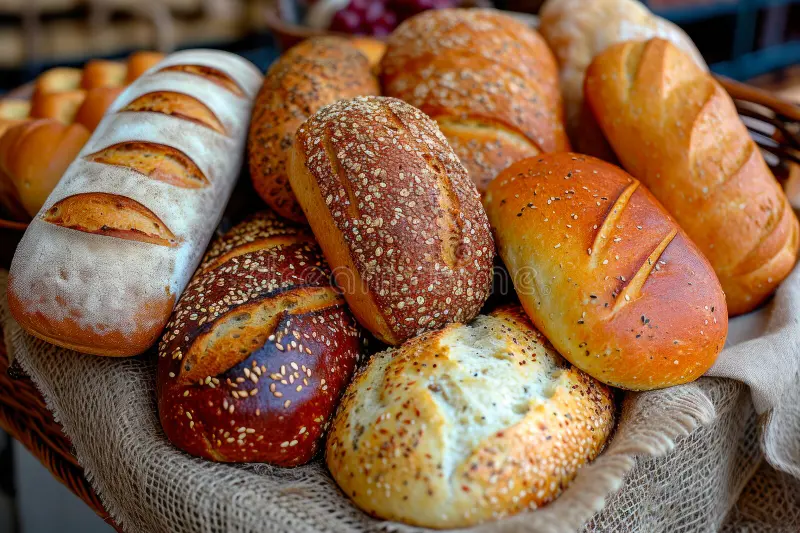
Italy does not have one bread. It has hundreds.
Every region, every city, and in some cases every village has a loaf it claims as its own, shaped by local wheat varieties, water quality, oven traditions, and centuries of baking culture that developed in near isolation before modern transportation connected the peninsula. The result is one of the most diverse bread traditions in the world, where a bread from Sicily and a bread from Lombardy can share almost nothing in common except flour and fire.
Most people outside of Italy encounter only a handful of these breads: ciabatta, focaccia, maybe a baguette-adjacent loaf labeled Italian bread at the grocery store. The actual range is considerably broader and considerably more interesting. Understanding the types of Italian bread, where they come from, what makes each one distinct, and how they are best used changes how you shop at a bakery, how you cook with bread, and how much you appreciate what a well-made loaf actually represents.
This guide covers the full spectrum, from everyday regional loaves to artisan breads, sourdough traditions, and the unleavened breads that predate yeast entirely.
What Makes Italian Bread Different
Before getting into specific types, it helps to understand what distinguishes Italian bread traditions from other European baking cultures.
Italian bread is shaped by geography more than almost any other food tradition. Italy is a long, narrow peninsula with dramatically different climates, soils, and agricultural conditions from north to south. The wheat grown in Sicily is different from the wheat grown in Tuscany. The water in Rome is different from the water in Naples. These differences, compounded over centuries of regional isolation, produced bread traditions that are genuinely distinct rather than superficially varied. Exploring the types of bread Italian bakers have developed across these regions reveals just how deeply geography shaped the national table.
Italian bread also reflects a fundamental philosophy about the relationship between bread and food. In most of Italy, bread is not the main event. It is the companion, the vehicle, the thing that makes the rest of the meal make sense. This produces loaves that are often less sweet and less enriched than American or French breads, with a neutral, slightly tangy flavor profile designed to complement food rather than compete with it.
The crust is taken seriously in Italian baking in a way that influences everything from oven temperature to steam management. A proper Italian bread crust is not just about texture. It is about flavor, since the Maillard reaction that occurs during high-heat baking produces the complex, slightly bitter, deeply savory notes that define many traditional Italian loaves.
The Classic Regional Loaves
These are the breads that define Italian baking at its most traditional: regional loaves tied to specific places, made the same way for generations, and built into the food culture of their home regions in ways that go beyond the bread itself.
Ciabatta
Ciabatta is the Italian bread most widely recognized outside of Italy, which is somewhat ironic given that it is one of the newest additions to the Italian bread canon. It was developed in 1982 by a baker in the Veneto region as a response to the growing popularity of French baguettes and was not an ancient recipe rediscovered but a new bread invented for a specific commercial purpose.
What ciabatta lacks in age it compensates for in adaptability. The bread is defined by its extremely high hydration dough, typically 70 to 80 percent water relative to flour, which produces the large, irregular air pockets and open crumb structure that make it immediately recognizable. The crust is thin and crisp. The interior is chewy, moist, and slightly tangy. The shape is flat and elongated, said to resemble a slipper, which is what ciabatta means in Italian.
Ciabatta handles heat well, which makes it ideal for panini and grilled sandwiches. It absorbs olive oil and vinegar without becoming immediately saturated, making it strong for bruschetta and dipping. Its open crumb holds soft fillings like burrata and roasted vegetables in a way that more closed-crumb breads do not.
Regional variations include ciabatta al latte, made with milk instead of water for a softer crumb, and the darker, more intensely flavored ciabatta integrale made with whole wheat flour.
Focaccia
Focaccia is among the oldest types of Italian bread, with origins that predate the Roman Empire and archaeological evidence suggesting flatbreads cooked on hot stones were common across the Mediterranean long before yeast bread became standard.
The defining characteristic of focaccia is olive oil: in the dough, on the surface, pooled in the dimples pressed into the top by hand before baking. The result is a bread that is simultaneously crispy on the bottom, tender in the interior, and richly flavored throughout from the fat worked into every layer of the dough.
Focaccia from Liguria, the coastal region where it arguably reached its highest expression, is relatively thin, intensely flavored with olive oil and sea salt, and sometimes topped with nothing more than a scattering of coarse salt and fresh rosemary. This is focaccia as bread, a companion to a meal rather than a meal itself.
Focaccia from other regions moves in different directions. Focaccia di Recco, also from Liguria, is a completely different product: two sheets of paper-thin unleavened dough filled with fresh stracchino cheese and baked at extremely high heat until blistered and crisped. It shares a name and an olive oil affinity with standard focaccia but is texturally and structurally its own thing.
In Puglia and parts of southern Italy, focaccia barese is thicker, softer, and often topped with cherry tomatoes, olives, and oregano in a preparation that begins to resemble pizza but predates the modern Neapolitan pie.
Pane di Altamura
Pane di Altamura is one of the few Italian breads protected by a DOP designation, meaning the name can only be applied to bread made in the Altamura area of Puglia using specific durum wheat semolina grown in the surrounding region.
The bread is made entirely from remilled durum semolina rather than soft wheat flour, which gives it a golden crumb color, a dense and slightly grainy texture, and a flavor profile that is earthier and more complex than breads made from standard soft wheat. The crust is thick and hard, traditionally baked in wood-fired ovens at temperatures that produce the deep amber crust that characterizes the loaf.
Pane di Altamura is one of the most shelf-stable Italian breads, historically staying good for up to two weeks when stored properly, which made it valuable in agricultural communities where daily baking was not practical.
Pane Toscano
Pane Toscano, or Tuscan bread, is the unsalted bread of Tuscany and one of the most surprising things to eat for the first time if you are not expecting it. The bread contains no salt whatsoever, a tradition that dates to a twelfth-century trade dispute between Tuscany and Pisa that cut off Tuscany’s salt supply and led bakers to develop recipes that worked without it.
The absence of salt produces a bread with a noticeably flat, almost neutral flavor that feels wrong until you eat it alongside the food it was designed to accompany: strongly flavored Tuscan cured meats, aged pecorino, bean soups, and game dishes where the salt content of the accompaniment is high enough that a salted bread would overwhelm the palate. Pane Toscano functions as a palate cleanser and a textural counterpoint rather than a flavor contributor.
It also makes exceptional bread for ribollita and pappa al pomodoro, Tuscan bread-based soups where stale bread is cooked into the broth. Unsalted bread absorbs liquid differently than salted bread and produces a thicker, more cohesive soup than salted bread would.
Pane di Matera
Pane di Matera comes from the ancient cave city of Matera in Basilicata and is one of the most visually distinctive Italian breads, shaped into a tall, horn-like crown that rises dramatically from the base. Like pane di Altamura, it is made from durum semolina and carries a DOP designation tied to its geographic origin and production method.
The bread has a pronounced crust, a dense golden crumb, and a complexity of flavor that comes from the long natural fermentation process traditionally used in its production. It keeps exceptionally well for a soft wheat bread and is part of a culinary tradition in Basilicata where resourcefulness and longevity were built into food preparation at every level.
Michetta
Michetta is the classic bread of Milan and the Lombardy region, a small, star-shaped roll with a dramatically hollow interior and a thin, very crisp crust. The hollow interior is not an accident or a baking failure. It is the intended structure, produced by a specific dough hydration and baking technique that causes steam to push the crumb away from the crust during baking, leaving an air pocket inside.
The result is a roll that is almost entirely crust. This makes it extraordinary for sandwiches where a wet filling, like braised meat or a sauced preparation, would turn ordinary bread soggy within minutes. The hollow interior absorbs liquid without becoming saturated in the way a standard crumb would, and the thick crust maintains its structure long after filling.
Michetta goes stale quickly because its thin crust has little moisture to give. It is at its best the day it is baked and should be bought and eaten accordingly.
Pane Carasau
Pane carasau is the traditional flatbread of Sardinia, made from durum semolina and water and baked twice to produce sheets of bread that are paper-thin, crackerlike, and shelf-stable for months. The name comes from the Sardinian word for toasting, which describes the second bake that crisps the bread after it has puffed and been split apart.
It was historically the bread of Sardinian shepherds who spent months in the mountains away from villages and needed food that would not spoil. Modern uses range from eating it plain with olive oil and salt, softening it briefly in water or broth for a dish called pane frattau, and using it as a crisp base for toppings in a preparation that resembles flatbread pizza.
Types of Artisan Bread in the Italian Tradition
Artisan bread is defined more by process than by a specific recipe: long fermentation, minimal commercial yeast, careful attention to dough development, and baking methods that prioritize crust and flavor over speed and uniformity. The Italian bread tradition has produced some of the most important artisan breads in the world.
Pane di Genzano
Pane di Genzano is a large, round sourdough loaf from the Castelli Romani area outside Rome, made with natural leavening, type 0 or type 00 flour, and baked in wood-fired ovens that produce a thick, dark crust dusted with wheat bran. It carries an IGP designation and is one of the defining examples of the Roman bread tradition.
The bread has a tight but open crumb, a slightly chewy texture, and a flavor that is complex without being aggressively sour. The thick crust insulates the interior and allows the loaf to remain good for several days without refrigeration. It is the kind of bread that improves slightly as it ages, making day-old slices excellent for bruschetta and bread-based preparations.
Pane Pugliese
Pane Pugliese is the everyday artisan bread of Puglia, a large round loaf with a golden, moderately thick crust and a soft, open crumb with irregular holes throughout. It is made from a combination of durum semolina and soft wheat flour, which gives it more tenderness than a pure semolina loaf while retaining the slight golden color and earthier flavor that durum contributes.
It is one of the most versatile Italian artisan breads for table use and performs well with everything from olive oil for dipping to the robust preparations of southern Italian cooking.
Filone
Filone is the elongated loaf and one of the most recognizable types of bread Italian bakeries produce for everyday use, closely resembling what American and non-Italian European bakers mean when they say Italian bread. It is a large, oblong loaf with a moderately open crumb, a golden crust, and a flavor profile that sits somewhere between the neutrality of a standard sandwich loaf and the complexity of a fully developed sourdough.
Filone made with commercial yeast and a short fermentation is a perfectly good everyday bread. Filone made with natural leavening and a long, cold fermentation is a considerably more interesting loaf with better crust development, a more complex flavor, and superior keeping qualities. The name simply means strand or line in Italian, describing the shape rather than a specific recipe, which is why filone varies so much across bakeries.
Types of Sourdough Bread in Italy
Sourdough, or bread made with a natural starter rather than commercial yeast, is not a trend in Italy. It is the original method, used for thousands of years before commercial yeast became available in the late nineteenth century. Many traditional Italian breads are naturally sourdough, even when they are not marketed as such.
Pane Acido
Pane acido translates directly as sour bread and is the closest Italian equivalent to what most people think of when they use the term sourdough. It is made with a mature natural starter, often maintained for years or decades in bakeries with long traditions, and given a long cold fermentation that develops both the complex flavor compounds and the acetic acid content responsible for the sour flavor.
The bread has a pronounced tang, a well-developed crust, and a chewy, open crumb that holds up well to robust fillings and intense accompaniments. It is more common in northern Italy, particularly in Piedmont and the alpine regions where cooler temperatures historically made maintaining a natural starter more practical than in the warmer south.
Pane di Segale
Pane di segale is rye bread, common in the alpine regions of Trentino-Alto Adige and Valle d’Aosta where rye grows better than wheat at altitude, and almost always naturally leavened with a sourdough starter rather than commercial yeast. The bread is dense, dark, and strongly flavored, with a pronounced acidity from the natural fermentation and a complexity that comes from rye’s higher fiber and enzyme content relative to wheat.
It is the bread of mountain communities and pairs particularly well with the strong aged cheeses, speck, and cured meats of the alpine Italian tradition. Its flavor is assertive enough that it functions as a flavor contributor rather than a neutral companion, which distinguishes it from most other Italian breads.
Pane Nero di Castelvetrano
Pane nero di Castelvetrano is a dark sourdough bread from western Sicily made from tumminia wheat, an ancient Sicilian grain variety, combined with durum semolina. The tumminia flour gives the bread its characteristic dark color, its dense crumb, and a deeply nutty, slightly sweet flavor that is unlike anything produced from modern wheat varieties.
The bread is made with a natural starter, baked in wood-fired ovens traditionally fueled with olive branches, and produced in limited quantities because tumminia wheat is still relatively rare even in Sicily. Finding it outside of Sicily requires seeking out specialty bakeries that import the grain or work with heritage grain suppliers, but it represents one of the most distinctive and historically significant breads in the Italian tradition.
Types of Unleavened Bread in Italy
Unleavened bread, bread made without any leavening agent whether commercial yeast, natural starter, or chemical leavener, predates yeast bread in human history and remains present in the Italian bread tradition both through ancient regional survivals and through specific culinary applications where a flat, crackerlike texture is functionally desirable.
Piadina Romagnola
Piadina is the flatbread of Emilia-Romagna, a thin disc of dough made from soft wheat flour, water, salt, and traditionally lard or olive oil, cooked on a hot griddle until lightly blistered and just cooked through. It is one of the most widely eaten breads in Italy today and one of the few unleavened breads that has crossed from regional tradition into national everyday use.
The texture is soft and pliable when fresh, with a slightly charred surface from direct contact with the hot griddle. It is used primarily as a wrap, filled with prosciutto, squacquerone cheese, and arugula in the most classic preparation, or with any number of combinations that reflect the filling traditions of the region.
Piadina stiffens quickly as it cools, so it is at its best eaten within minutes of cooking. Bakeries and street food stands in Emilia-Romagna cook and fill them to order, and that is the proper way to encounter them.
Crescentine Fritte
Crescentine fritte, sometimes called gnocco fritto in parts of Emilia-Romagna, are small squares of unleavened dough fried in lard until puffed, golden, and hollow in the center. They are served hot alongside cured meats and soft cheeses, and the combination of the crispy, slightly greasy fried bread with the richness of culatello or mortadella is one of the great simple pleasures of the Emilian table.
Despite the name connecting them to gnocco, they share nothing with the potato dumpling. The name refers to the dough, not the final texture, and the fried result is crispier and more hollow than any gnocco.
Carta di Musica
Carta di musica, or music paper bread, is another name for pane carasau when it is made at its thinnest, so thin and crisp that it crinkles like paper and is said to resemble the pages of old music manuscripts when stacked. While pane carasau can vary in thickness, carta di musica specifically refers to the thinnest, most crackerlike version and is used almost entirely for eating plain or with simple toppings rather than for softening in liquid.
Tigelle
Tigelle are small, round flatbreads from the Apennine mountains of Emilia, cooked between special terracotta discs called tigelle that were historically heated in the fire. The bread is slightly thicker than a piadina and denser in texture, traditionally split and filled with a mixture called cunza, made from lard, rosemary, and garlic, though modern preparations use everything from prosciutto to Nutella.
Tigelle are properly eaten hot, split immediately after cooking, and filled quickly before they cool. They are street food, mountain food, and party food simultaneously, the kind of bread that builds social occasions around the cooking rather than being prepared quietly in advance.
How to Use This Guide at the Bakery
Understanding the types of Italian bread available at a well-stocked bakery changes the experience of buying bread from a simple errand into something more considered.
When you see ciabatta, you know you are looking at a bread designed for sandwiches and bruschetta, not for mopping up soup. When you see a whole pane di Altamura or a loaf of pane toscano, you know the former is built to last several days and the latter will taste flat until you eat it alongside something strongly flavored. When you see focaccia di Recco, you know to eat it immediately rather than saving it for later.
The types of artisan bread at any serious bakery reflect the baker’s philosophy and sourcing as much as the recipes themselves. Asking questions about the leavening method, the flour type, and the fermentation time gives you useful information and often produces a more interesting conversation than most grocery store experiences offer.
Fresh Italian Bread at Key Food Hollywood
A great bakery section makes the difference between bread as an afterthought and bread as a genuine part of the meal.
Key Food Hollywood carries fresh bread and bakery items that serve the diverse cooking traditions of Hollywood, FL’s Latin, Caribbean, and broader communities. Whether you are shopping for a loaf to serve alongside a full meal, looking for bread for sandwiches, or simply want something worth eating on its own with good olive oil, the bakery section is worth visiting with the same attention you give the rest of your shopping.
Stop by Key Food Hollywood and see what is fresh today. Good bread, bought from a store that takes it seriously, makes everything at the table better.
FAQs
What are the main types of Italian bread?
The main types include ciabatta, focaccia, pane toscano, pane di Altamura, michetta, piadina, and pane carasau, among many regional varieties. Each comes from a specific region of Italy and reflects the local wheat, water, and baking traditions of its origin.
What is the difference between artisan bread and regular bread?
Artisan bread is made using longer fermentation, minimal commercial yeast, careful dough development, and baking methods that prioritize crust development and flavor. Regular commercial bread uses faster processes, more commercial yeast, and often additional additives to extend shelf life and standardize texture.
What types of Italian bread are made with sourdough?
Many traditional Italian breads are naturally leavened, including pane di Genzano, pane acido, pane di segale, pane nero di Castelvetrano, and pane di Altamura. Sourdough fermentation is the original leavening method in Italy and predates commercial yeast by thousands of years.
What are the types of unleavened bread in Italy?
Piadina romagnola, crescentine fritte, carta di musica, tigelle, and pane carasau are among the most significant Italian unleavened or minimally leavened breads. Each comes from a specific regional tradition and is used in distinct culinary contexts.
Why is Tuscan bread made without salt?
Pane toscano is unsalted because of a historical trade dispute in the twelfth century that cut off Tuscany’s salt supply. Bakers developed saltless recipes that worked alongside the strongly flavored cured meats, aged cheeses, and bean dishes of the Tuscan table, where the salt content of the food itself made a neutral bread more functional than a salted one.
What is the best Italian bread for sandwiches?
Ciabatta, michetta, and filone are the strongest choices for sandwiches. Ciabatta handles wet fillings and grilling well. Michetta’s hollow interior is ideal for sauced preparations that would turn other breads soggy. Filone is the most versatile general-purpose option for everyday sandwiches.